
Flushing Out the Numbers: Average Cost to Add a Bathroom
What Is the Average Cost to Add a Bathroom?
The average cost to add bathroom space in 2026 is about $15,000 to $50,000 nationwide. A small half-bath conversion may cost as little as $5,000 to $15,000, while a new full bathroom addition often runs $25,000 to $75,000 or more.
Your fastest way to estimate the budget is to answer three questions:
- Are you converting existing space or building outward? Converting a closet, laundry room, or nearby bedroom is usually far less expensive than a new exterior addition.
- How close is the new bathroom to plumbing? Sharing a wall with an existing kitchen or bathroom can save thousands in new drain, water, and vent lines.
- What type of bathroom do you need? A powder room needs only a toilet and sink. A full or primary bathroom also needs shower or tub plumbing, waterproofing, ventilation, and more finishes.
Labor, plumbing, electrical upgrades, permits, and fixture choices can shift the final number quickly. Plan for a contingency of roughly 10% to 20% for issues hidden behind walls, under floors, or in aging pipes. For broader context on how these costs compare with other home improvements, the National Association of Home Builders publishes regular construction cost surveys that can help you benchmark your project.
I am Mark Apicella, Owner and President of Turn Key Remodel in Orange County, with more than eight years of experience guiding homeowners through bathroom remodels, additions, design decisions, and project budgeting. Understanding the average cost to add bathroom space starts with a clear scope, then matching the layout and finishes to your home and goals.
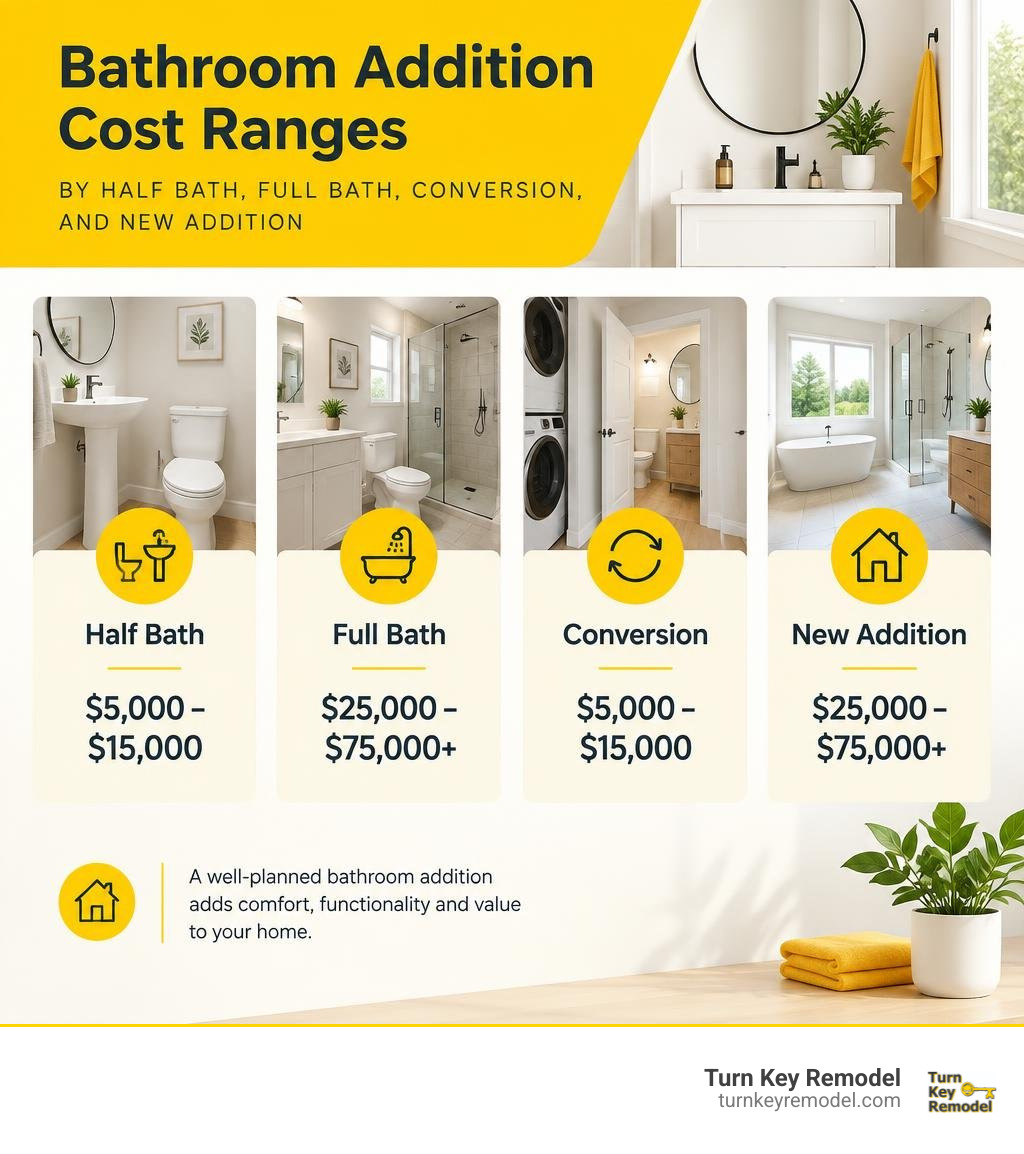
Terms related to average cost to add bathroom:
What Is the Average Cost to Add Bathroom in 2026?
When tackling a major home renovation, understanding the broad pricing landscape prevents sticker shock. Most homeowners spend an average of $35,000 to add a complete bathroom to their property, though figures range from as low as $5,000 for a straightforward powder room conversion to upwards of $75,000 to $90,000+ for an upscale, ground-up primary suite addition.
On a per-square-foot basis, bathroom additions average around $375 per square foot. Converting existing interior space runs roughly $200 to $250 per square foot, while ground-up additions with new foundations and framing can easily climb to $400 to $550+ per square foot.
Labor represents the largest slice of the pie, making up 40% to 55% of the total budget. Plumbing, electrical wiring, waterproofing, tiling, and cabinetry require licensed trade specialists to ensure safety and structural longevity. Reviewing our essential checklist for bathroom remodel costs can help you keep these moving parts organized from day one.
| Bathroom Project Type | Typical Square Footage | Cost Range (Conversion) | Cost Range (New Addition) | Average Expected Total |
|---|---|---|---|---|
| Half-Bath / Powder Room | 18 – 30 sq. ft. | $5,000 – $15,000 | $10,000 – $30,000 | $18,000 |
| Three-Quarter Bath | 30 – 45 sq. ft. | $10,000 – $20,000 | $15,000 – $35,000 | $26,000 |
| Full Bathroom | 40 – 60 sq. ft. | $15,000 – $35,000 | $25,000 – $55,000 | $35,000 |
| Primary / Ensuite Suite | 75 – 150+ sq. ft. | $25,000 – $50,000 | $40,000 – $90,000+ | $60,000 |
Comparing the Average Cost to Add Bathroom by Room Type
The specific type of bathroom you select dictates the complexity of the plumbing network, the square footage required, and the fixture count:
- Half-Bath (Powder Room): Equipped with only a toilet and a sink, these compact spaces (often 18 to 30 square feet) avoid the expense of shower pans, waterproofing membranes, and complex drain assemblies. They are ideal for guest access near living areas or tucked beneath staircases.
- Three-Quarter Bath: Typically featuring a toilet, single vanity, and a standing shower stall, three-quarter bathrooms balance utility and space efficiency. They are great choices for guest rooms or finished basements.
- Full Bathroom: Containing a sink, toilet, and a bathtub or tub/shower combo, standard full baths (typically 40 to 60 square feet) serve busy families and preserve home appraisal value.
- Primary Ensuite: Designed as a personal retreat, primary bathrooms include double vanities, separate walk-in showers, freestanding soaking tubs, custom tile, and enclosed water closets.
Careful planning and execution for bathroom additions ensures that whichever room type you choose aligns with your household’s daily routines and long-term resale goals.
Average Cost to Add Bathroom: Space Conversion vs. New Build Extension
Deciding whether to repurpose internal square footage or push exterior walls outward is one of the most consequential decisions you will make.

- Interior Space Conversions: Transforming an existing closet, laundry room, underutilized hallway, or spare bedroom into a bathroom typically costs $5,000 to $35,000. Because the existing roof, exterior siding, and foundation are already in place, your dollars go straight toward demolition, rough-in trades, framing modifications, and finishes. Converting a laundry room is especially cost-effective because supply lines and drainage are often nearby.
- New Build Extensions (Bump-Outs): Building an exterior addition starts around $20,000 and can easily exceed $75,000 to $90,000. This approach involves architectural engineering, foundation excavation, framing exterior walls, tying into the roofline, installing exterior siding, and expanding insulation envelopes.
Before committing to expanding your home’s footprint, review our guide to understanding realistic bathroom conversion costs to explore how maximizing your existing layout can save substantial money.
Key Cost Drivers: Plumbing, Electrical, and Material Breakdown
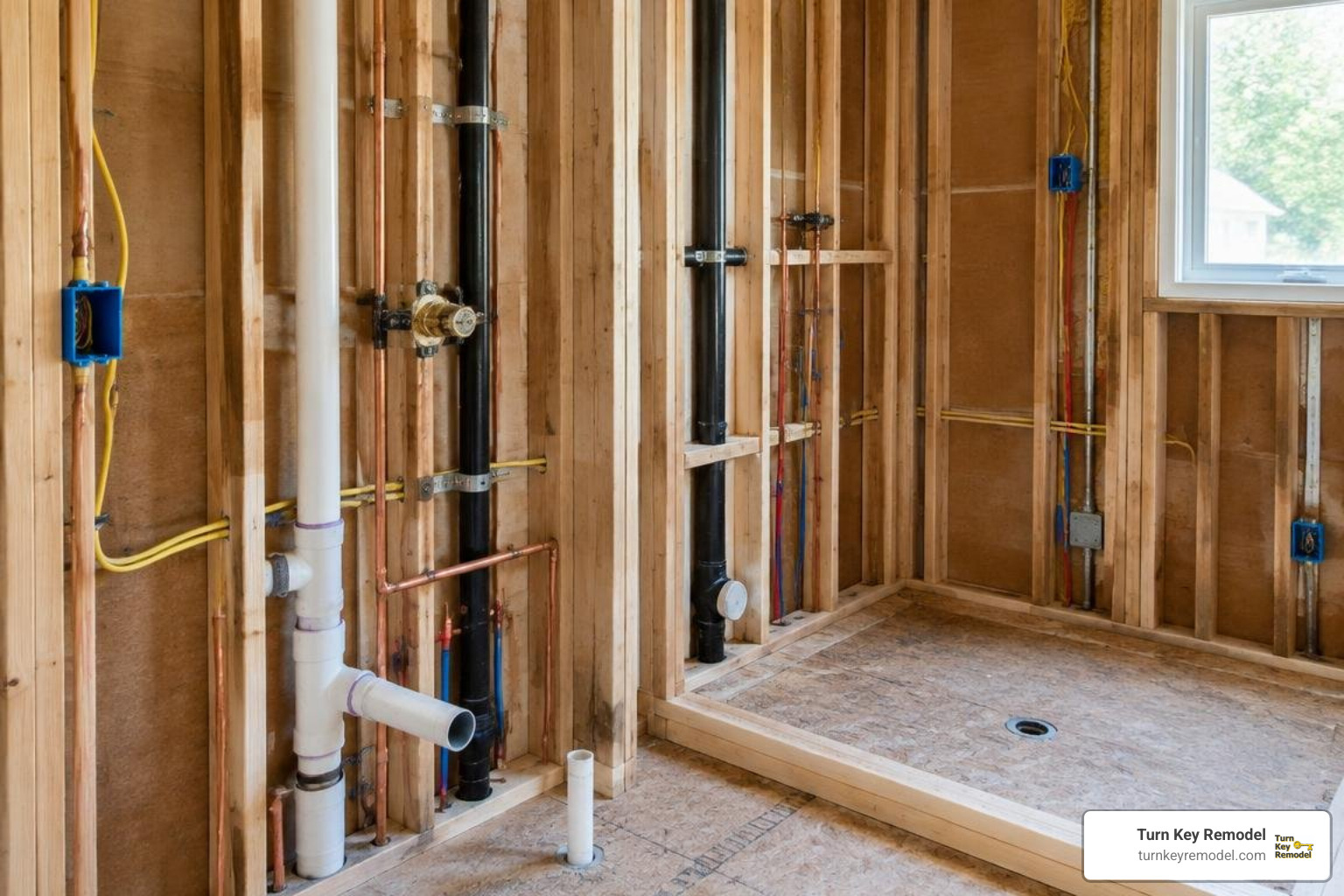
The behind-the-wall infrastructure accounts for a significant portion of your total investment. The distance to your home’s main sewer stack and existing water supply lines directly dictates labor intensity. When your new bathroom shares a “wet wall” with an adjacent kitchen or existing bath, plumbers can tap directly into nearby supply and vent stacks, saving thousands.
Infrastructure & Trade Cost Benchmarks
- Plumbing Rough-In: Licensed plumbers charge between $45 and $200 per hour. Installing fresh water supply lines, waste drains, and venting costs between $1,500 and $10,000+ depending on the complexity of the run. While small maintenance tasks might make you weigh plumber rates vs DIY faucet replacement, structural rough-ins must always be executed by licensed professionals.
- Electrical Upgrades: Modern building codes (NEC) mandate dedicated 20-amp circuits for bathroom receptacles, GFCI protection to prevent shocks in wet zones, and dedicated circuits for high-draw ventilation fans, radiant floor heating, and lighting. Electricians bill $50 to $150 per hour, totaling $1,000 to $3,500 for a standard installation.
- Drywall & Moisture Barriers: Moisture-resistant greenboard or cement backer boards paired with waterproofing membranes (like Schluter Systems) cost $1,000 to $2,500 installed.
- Permitting & Inspections: City plan checks, trade permits, and building inspections range from $300 to $2,000 depending on your municipality.
Location Logistics: Basement, Attic, and Upstairs Installations
Where you place the bathroom in your home impacts engineering hurdles:
- Upstairs Additions ($8,000 – $35,000+): Adding a bathroom upstairs requires verifying that floor joists can handle the dead load of a water-filled tub or heavy tile bed. Plumbers must route drain lines downward through lower-level walls, which occasionally requires drywall cutouts below.
- Basement Installations ($8,000 – $25,000+): If your main sewer exit sits higher than the basement floor, plumbing fixtures cannot drain by gravity alone. You will need concrete slab saw-cutting, trenching, and a dedicated sewage ejector pump system ($1,500 – $4,500). Explore our guide on adding a bathroom to a basement with plumbing layouts for deep-dive technical insights.
- Attic & Garage Conversions ($8,000 – $35,000): Attics require roofline clearance, dormer framing, and extensive supply pipe insulation against thermal shifts, while garage conversions demand trenching through concrete slabs and upgrading subpanels.
Fixture Selection and Shower Configurations
Finish selections can make or break your renovation budget. Fixtures and surface materials make up roughly 45% of total project costs, and prices vary widely:
- Showers and Tubs: A standard fiberglass or acrylic prefabricated shower unit costs $1,200 to $3,500 installed. A custom curbless tile walk-in shower with frameless glass doors ranges from $4,500 to $12,000+. If you are reconfiguring spaces, review our breakdown of tub to shower conversion cost factors to balance functionality with your budget.
- Vanities & Countertops: Prefabricated vanities with integrated sinks cost $400 to $1,500, while custom double vanities with quartz or marble countertops can reach $2,500 to $6,000+.
- Toilets: Standard gravity-fed commodes run $200 to $500, while smart toilets with integrated bidets and heated seats range from $1,200 to $3,500+.
Return on Investment and Long-Term Home Value
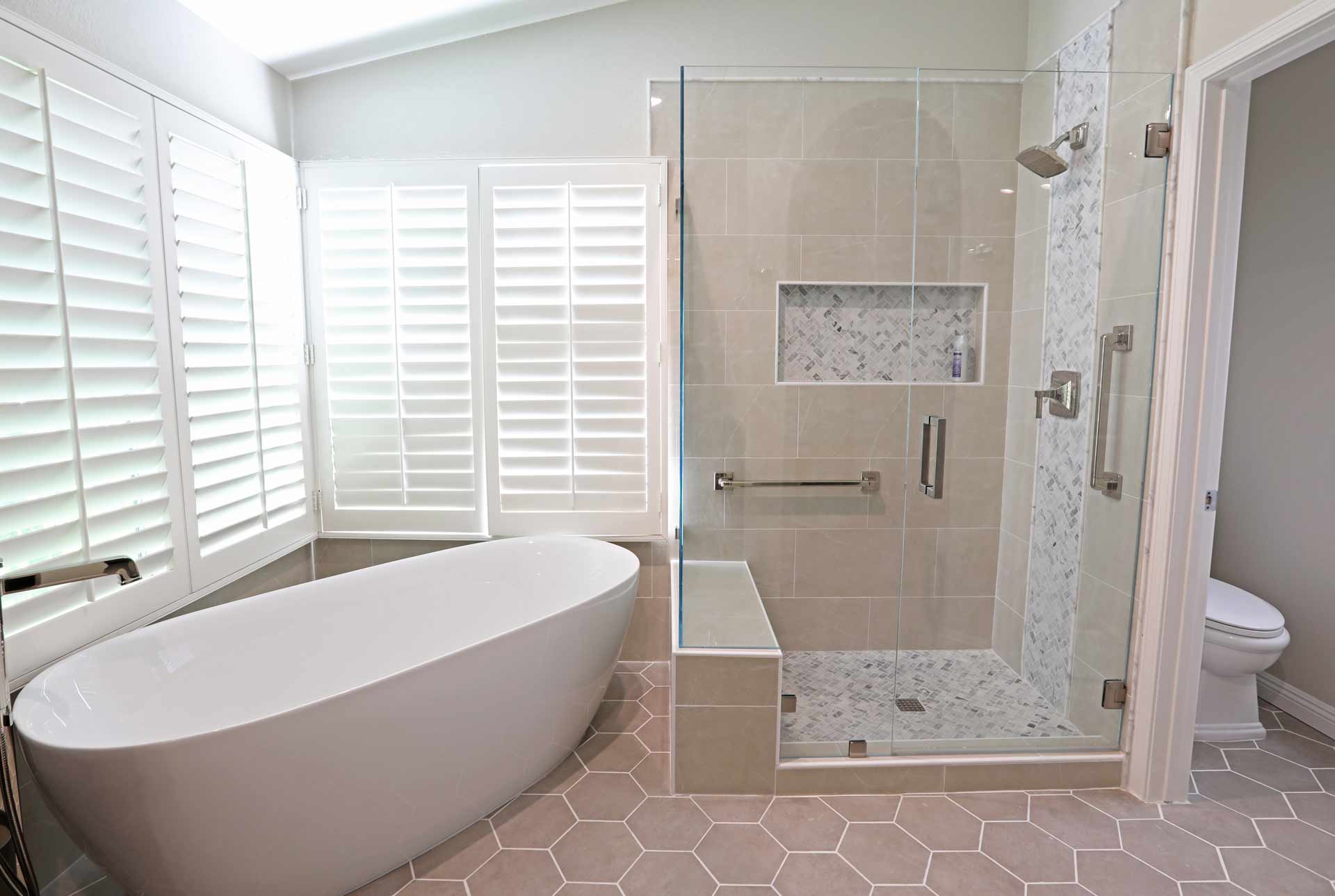
Beyond immediate lifestyle improvements, adding a bathroom is an investment in your home’s equity. According to national real estate and construction cost data, a midrange bathroom addition yields an average 50% to 65% return on investment (ROI) at resale.
In homes that previously had only one bathroom, adding a second full or half-bath can yield an ROI exceeding 80% to 100%, as single-bathroom homes face stiff resistance from prospective buyers. Industry data indicates that adding a bathroom can lift overall property market value by 10% to 30% (often $20,000 to $50,000+ depending on neighborhood comparables).
To maximize your return, avoid over-improving beyond your neighborhood standard. Selecting high-quality, durable materials—such as porcelain tile, quartz countertops, and timeless brushed nickel or matte black fixtures—appeals broadly to appraisers and homebuyers alike.
Hidden Expenses and Budget-Saving Strategies
Unexpected expenses can catch homeowners off guard if they are not planned for in advance. Protect your budget by preparing for common hidden costs:
- Hidden Water Damage or Dry Rot: Discovering subfloor deterioration after pulling up old flooring can add $1,000 to $3,000 in structural repairs.
- Main Electrical Panel Upgrades: If your home’s electrical service is maxed out, upgrading to a 200-amp panel costs $1,800 to $4,000.
- Water Heater Capacity: Adding a large soaking tub or multi-head shower may overwhelm an older 40-gallon tank, requiring an upgrade to a tankless water heater ($2,500 – $4,500).
Smart Strategies to Save Money:
- Maintain Close Proximity to Wet Walls: Tying into existing supply and drain lines rather than crossing to the opposite side of the home saves thousands in plumbing labor.
- Opt for High-End Lookalikes: High-definition porcelain tile can replicate the look of natural Calacatta marble for a fraction of the material and sealing maintenance cost.
- Choose Quality Stock Cabinetry: Pre-assembled solid wood vanities often provide the same visual appeal and durability as custom cabinetry at half the price.
- Partner with an Experienced Design-Build Team: Avoiding change orders through detailed 3D design and single-source contracting is the most reliable way to keep your budget on track. Learn more about vetting reliable local bathroom remodel contractors before signing any agreements.
Frequently Asked Questions About Adding a Bathroom
Can you add a bathroom anywhere in a house?
Technically, yes, provided there is sufficient physical clearance, access to ventilation, and the structural capacity to route plumbing. The primary constraint is gravity drainage: wastewater lines must maintain a minimum downward slope of 1/4-inch per linear foot toward the main sewer stack. Where gravity drainage is impossible (such as basements below the sewer line), specialized sewage ejector pumps or upflush macerating toilet systems must be installed.
Do you need a permit to add a bathroom?
Yes. Every reputable municipality requires building, electrical, and plumbing permits for a bathroom addition. Permitting ensures that structural modifications, circuit load calculations, ventilation rates, and drainage assemblies comply with local and International Residential Code (IRC) standards. Skipping permits can trigger stop-work orders, steep municipal fines, and major complications during homeowner insurance claims or property resale.
How long does a bathroom addition project take?
A standard space-conversion bathroom project typically takes 3 to 6 weeks of active construction once permits are approved. A ground-up exterior addition generally takes 8 to 16 weeks due to foundation excavation, concrete curing, structural framing, exterior siding, and roofing tie-ins. Supply chain lead times for custom vanities or specialty tile should always be accounted for prior to demolition.
Conclusion
Adding a bathroom is one of the most rewarding home renovations you can undertake, providing daily convenience while building long-term equity. Whether you are transforming a small under-stair closet into a half-bath or expanding your floor plan to build an ensuite retreat, success comes down to careful planning, realistic budgeting, and experienced craftsmanship.
At Turn Key Remodel, we bring design-build expertise, in-house interior design, and dedicated project management to every project across Orange County—including Yorba Linda, Placentia, Anaheim Hills, Tustin, and Brea. We handle your renovation seamlessly from initial 3D design concepts and permitting through final fixture installation, on time and on budget.
Ready to explore your home’s possibilities? Visit our professional bathroom remodeling services page today to schedule your complimentary design consultation and estimate.