Choose Turnkey Contracts to Simplify Complex Commercial Builds
Understanding the Turn Key Project Meaning and Core Delivery Model
At its foundation, understanding the turn key project meaning requires looking at who shoulders the ultimate responsibility for bringing a concept into reality. The term originated in 20th-century construction and engineering to describe the milestone moment when a building is so complete that the owner needs only to turn the key in the lock to begin operations.
According to the formal definition of a turnkey project, it represents a delivery model where a single contractor assumes comprehensive responsibility for every phase required to make a facility operational. Rather than passing responsibility from one party to another as plans move from paper to physical framing, the entire lifecycle is unified under one overarching entity.
In standard construction arrangements, project owners often find themselves acting as referee between separate design firms and general contractors. When a structural detail clashes with an electrical run or a plumbing line, the builder blames the architect, and the architect blames the builder. Under a turnkey approach, that interface friction disappears. The contractor owns the design integrity, the procurement logistics, the physical construction, and the final commissioning.
Turn Key Project Meaning in Commercial and Residential Builds
While the model gained heavy traction in massive industrial plants and energy infrastructure, the core principles apply directly to modern commercial build-outs, tenant improvements, and comprehensive residential renovations. In both residential and commercial spheres, the ultimate goal is move-in readiness.
Within the turnkey legal framework, legal scholars and construction authorities note that design liability and performance obligations rest entirely with the contractor. For an office build-out, retail storefront, or custom residential estate, this means you do not receive an empty shell with loose wiring and unpainted drywall. You receive a fully finished space equipped with operational utilities, finished surfaces, installed fixtures, and passed municipal inspections.
Whether you are expanding a corporate suite or executing high-end residential renovations, partnering with a contractor that offers comprehensive commercial services guarantees that space planning, material selections, and physical trades coordinate seamlessly under one roof.
Essential Features of Turnkey Construction Agreements
A turnkey project relies on specific contractual mechanisms to protect both the client and the builder throughout execution. As outlined by the standard turnkey contract definition, the agreement legally binds the contractor to deliver a fully functional asset that the client can use immediately without performing supplemental work.
Key features of these agreements include:
- Lump-Sum, Fixed Pricing: The total cost is established before major construction starts. Unless the owner requests an explicit change of scope later, the contractor absorbs market price swings for materials and labor.
- Guaranteed Delivery Schedules: The contract sets firm milestones and a clear completion date, minimizing operational downtime for commercial enterprises.
- Consolidated Scope of Work: Architectural drawings, engineering calculations, structural framing, mechanical trades, interior finishes, and final utility tie-ins are bundled into one document.
- Strict Quality Control and Acceptance Regimes: The contract outlines clear acceptance criteria and testing protocols that must be satisfied before final handover occurs.
- Direct Performance Guarantees: The contractor warrants that the finished structure meets all operational, structural, and environmental standards agreed upon during the planning phase.
Turnkey vs. Traditional Delivery: EPC, LSTK, and Non-Turnkey Models
Navigating construction procurement terms can feel like swimming through alphabet soup. You will often hear industry professionals mention Turnkey, EPC, and LSTK interchangeably. While closely related, each term highlights a distinct dimension of the project delivery structure.
How the Turn Key Project Meaning Applies to EPC and LSTK
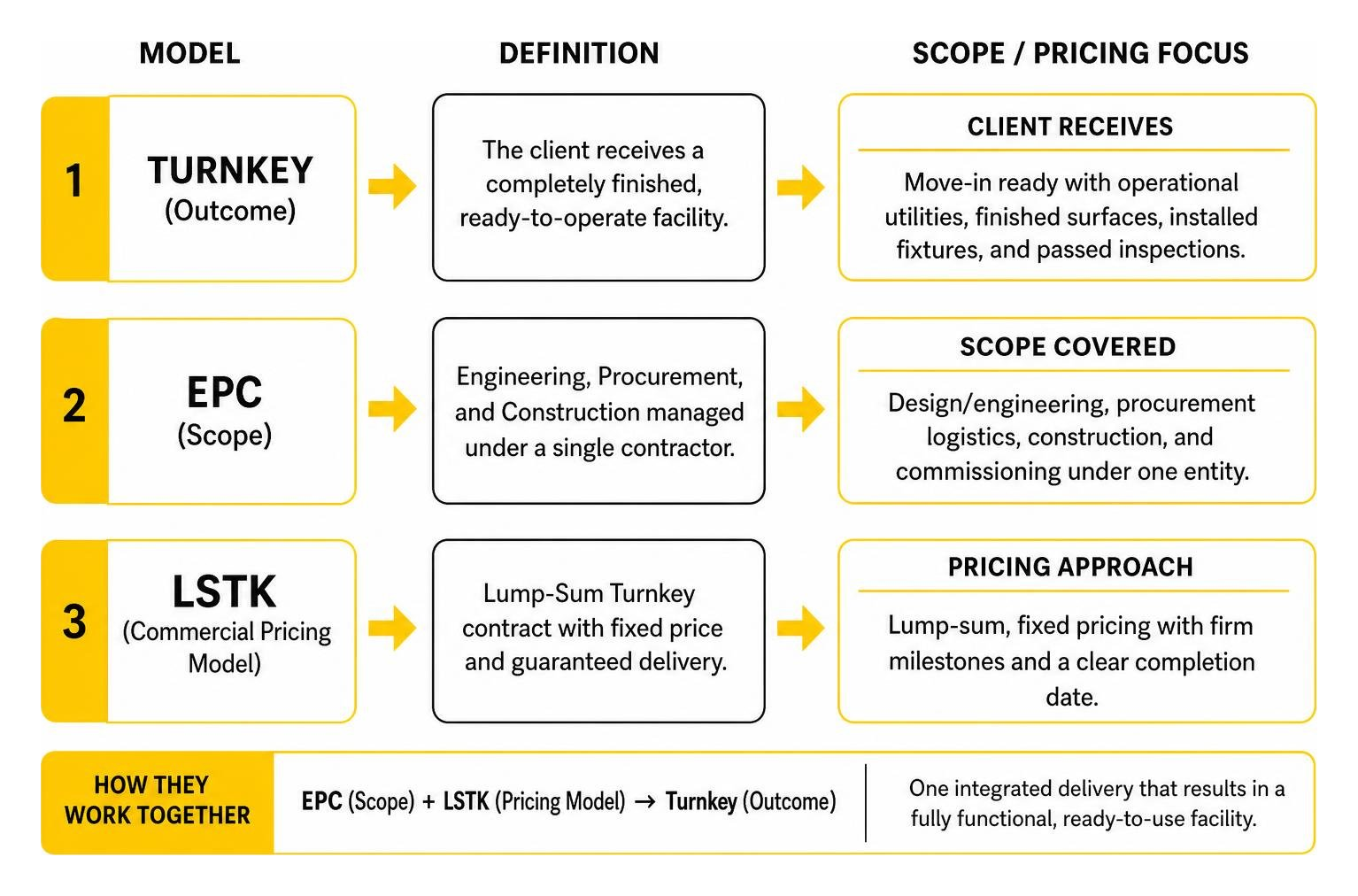
To understand how these concepts interact, it helps to distinguish the delivery outcome from the operational scope and the pricing model:
- Turnkey (The Outcome): Describes what the client receives—a completely finished, ready-to-operate facility.
- EPC (The Scope): Stands for Engineering, Procurement, and Construction. It describes what the contractor actually does to achieve the turnkey outcome.
- LSTK (The Commercial Model): Stands for Lump-Sum Turnkey. It defines the financial risk structure, meaning the comprehensive EPC scope is delivered for a single, fixed lump-sum price.
In practice, an EPC contract is the execution vehicle for a turnkey project. However, an LSTK structure only functions smoothly when the project scope has reached sufficient maturity before signing. If an owner attempts to lock in a lump-sum turnkey contract before preliminary site investigations, structural goals, and architectural plans are clearly defined, contractors must add massive risk contingencies to their pricing, or disputes will arise over unforeseen site conditions.
Comparing Turnkey and Non-Turnkey Procurement Strategies
The contrast between turnkey contracting and traditional non-turnkey procurement (such as the classic Design-Bid-Build model) comes down to where interface risk and management burdens sit.
| Delivery Feature | Turnkey / EPC Model | Non-Turnkey (Design-Bid-Build) | Design-Build Model |
|---|---|---|---|
| Point of Contact | Single unified entity | Multiple (Architect, GC, Trades) | Single unified entity |
| Design Liability | Contractor | Project Owner / Architect | Contractor / Design Team |
| Cost Predictability | High (Locked Lump-Sum) | Low to Moderate (Prone to change orders) | Moderate to High |
| Owner Management Burden | Minimal oversight needed | Heavy administrative coordination | Moderate collaboration |
| Schedule Speed | Fast (Overlapping phases) | Slower (Sequential phases) | Fast (Overlapping phases) |
| Risk Allocation | Transferred to contractor | Retained largely by owner | Shared / Balanced |
In a non-turnkey approach, the owner contracts separately with an architect to produce complete plans, then solicits competitive bids from multiple general contractors. While this allows the owner to scrutinize every design line item, it leaves them holding the bag if drawings contain omissions or errors. If something fails on site, the trade contractor claims the blueprints were flawed, while the architect claims the contractor misread the specifications.
A turnkey approach eliminates this finger-pointing by placing complete responsibility for both design accuracy and trade execution on the contractor.
Advantages, Disadvantages, and Best-Fit Scenarios for Turnkey Projects

Every construction delivery model involves trade-offs. Choosing a turnkey agreement requires balancing your desire for hands-off convenience and price certainty against the level of day-to-day administrative control you wish to maintain.
Key Benefits and Trade-Offs for Owners
The advantages of a turnkey build include:
- Fixed Cost Certainty: Because the scope is unified under a fixed price, owners avoid the surprise billing and runaway change orders that plague traditional builds.
- Compressed Timelines: Design, permitting prep, and long-lead material procurement can occur concurrently rather than sequentially, accelerating total project delivery.
- Minimized Administrative Strain: Business owners and property managers do not need to spend hours each week coordinating between subcontractors, resolving site disputes, or chasing permit approvals.
- Clear Accountability: There is only one phone number to call for updates, modifications, questions, or warranty service.
The potential disadvantages to consider:
- Reduced Mid-Stream Flexibility: Because pricing and materials are locked in before site work begins, making substantial design changes halfway through construction can be costly.
- Less Granular Control: If you are an owner who wants to micromanage every screw, paint stroke, and sub-tier supplier selection, the turnkey approach may feel restrictive.
- Upfront Scope Clarity Required: You must invest time during early planning to clearly define your functional expectations and finish standards so the contractor can price and build the space accurately.
When to Choose Turnkey Delivery Over Other Procurement Methods
Turnkey delivery is the ideal strategy when:
- You have strict deadlines: Commercial enterprises that need to open retail doors or occupy office space by an immovable date benefit from unified schedule control.
- Your internal team lacks construction bandwidth: If you do not have dedicated in-house construction managers to oversee architects and trades daily, outsourcing management to a single provider prevents project burnout.
- You want predictable financing: Lenders and investors favor the cost certainty of fixed-price turnkey contracts because they eliminate contingency creep.
- The project has complex technical interfaces: Spaces requiring specialized electrical, mechanical, plumbing, and aesthetic integrations run far smoother when managed by a single cohesive team.
Taking time for planning a successful build during the initial concept phase ensures your functional requirements are locked down, setting the stage for a seamless turnkey execution.
Key Phases and Completion Stages of a Turnkey Project
A successful turnkey build follows a structured lifecycle from initial concept through to final occupancy. Because the contractor orchestrates all phases, each step transitions naturally into the next.

From Design and Permitting to Procurement and Construction
The project progresses through five distinct execution stages:
- Scope Definition and Feasibility: We collaborate with you to define your functional requirements, aesthetic goals, budget baselines, and performance expectations.
- Integrated Architectural Design and Permitting: In-house designers and engineers create comprehensive construction drawings. Because builders and designers work in tandem, the drawings account for practical buildability from day one. The contractor manages all submittals with municipal building departments to secure necessary structural, mechanical, and electrical permits.
- Strategic Procurement: Materials, fixtures, structural elements, and equipment are ordered early. Consolidating procurement under one manager avoids scheduling bottlenecks and ensures material compatibility across trades.
- Physical Construction and Trade Management: The contractor mobilizes site crews, oversees demolition, structural framing, utility installations (HVAC, plumbing, electrical), drywall, and architectural finishes while handling daily site safety and quality inspections.
Commissioning, Testing, and Final Takeover
The final stage of a turnkey build separates it from basic general contracting:
- Commissioning, Testing, and Handover: Before you receive the keys, every installed system undergoes functional performance testing. HVAC systems are balanced, lighting controls and circuits are tested under load, plumbing systems are pressurized, and fire life-safety systems are verified.
Once all municipal inspections pass and punch-list items are resolved to complete satisfaction, the contractor hands over the operational facility along with manuals, warranty documentation, and as-built drawings. You walk into a spotless, fully functional building ready for immediate occupancy.
Frequently Asked Questions About Turnkey Contracting
What is the primary difference between a turnkey contract and a traditional contract?
The primary difference lies in who manages interface risk and holds project accountability. In a traditional construction contract (Design-Bid-Build), the owner hires an architect to design the plans and separately hires a general contractor to build them, leaving the owner to manage communication gaps, change orders, and schedule coordination between both parties.
In a turnkey contract, a single contractor manages every phase—from initial architectural drawings and permits through construction, finishes, and testing—delivering a move-in-ready building under a single point of responsibility.
Who carries the financial risk in a turnkey project?
In a standard turnkey agreement structured on a lump-sum basis, the financial risk of cost overruns and material price fluctuations sits primarily with the contractor. Because the contractor establishes a fixed price based on an agreed-upon scope of work, they must manage labor efficiency, supplier pricing, and project scheduling effectively to complete the job within that budget.
The client is shielded from unexpected cost increases unless they choose to alter the project scope after the contract is executed.
What industries commonly utilize turnkey project delivery?
Turnkey project delivery is widely utilized across multiple industries where speed, coordination, and operational readiness are essential. Common sectors include:
- Commercial & Office Development: Corporate headquarters, medical suites, and professional offices requiring custom tenant improvements and immediate occupancy.
- Industrial & Automated Warehousing: Logistics centers and manufacturing plants integrating complex conveyor systems, high-voltage power, and specialized civil envelopes.
- Residential Renovation & Custom Homes: Whole-home remodels, luxury kitchen and bathroom transformations, and accessory dwelling units (ADUs) where homeowners prefer an end-to-end design-build service.
- Energy & Infrastructure: Power generation facilities, solar-storage arrays, and municipal utility plants where extensive engineering and strict commissioning standards are required.
Conclusion
Navigating a major commercial build-out or extensive property renovation does not have to involve fractured communication, endless finger-pointing, or budget surprises. By utilizing a turnkey delivery model, you streamline the entire development journey—unifying architectural design, permitting logistics, trade execution, and quality control under a single accountable partner.
At Turn Key Remodel, we bring over two decades of craftsmanship and dedicated project management to property owners across Orange County, including Yorba Linda, Placentia, Anaheim Hills, Tustin, and Brea. Our team provides 24/7 transparent communication, fixed-cost predictability, and complete in-house design and construction services that take your project seamlessly from raw concept to finished key handover. Contact us today to discuss your next build and experience how simple construction can be when one expert team handles it all.