
Transform Your Vanity with Elegant Backlit Mirror Lighting
Choosing a Bathroom Backlit Mirror for Your Vanity
Choose a bathroom backlit mirror that is no wider than your vanity, with a shape that fits the space above your sink. Look for dimmable LEDs, adjustable color temperature, and an anti-fog feature if you use the mirror after showering. For makeup or shaving, choose a model with front and back lighting and a CRI of 90 or higher: the backlight creates a soft glow on the wall, while the front light helps illuminate your face.
I’m Mark Apicella, owner and president of Turn Key Remodel in Orange County. With more than eight years in remodeling, I help homeowners plan bathroom upgrades, including how a bathroom backlit mirror fits the vanity, lighting, and overall design.
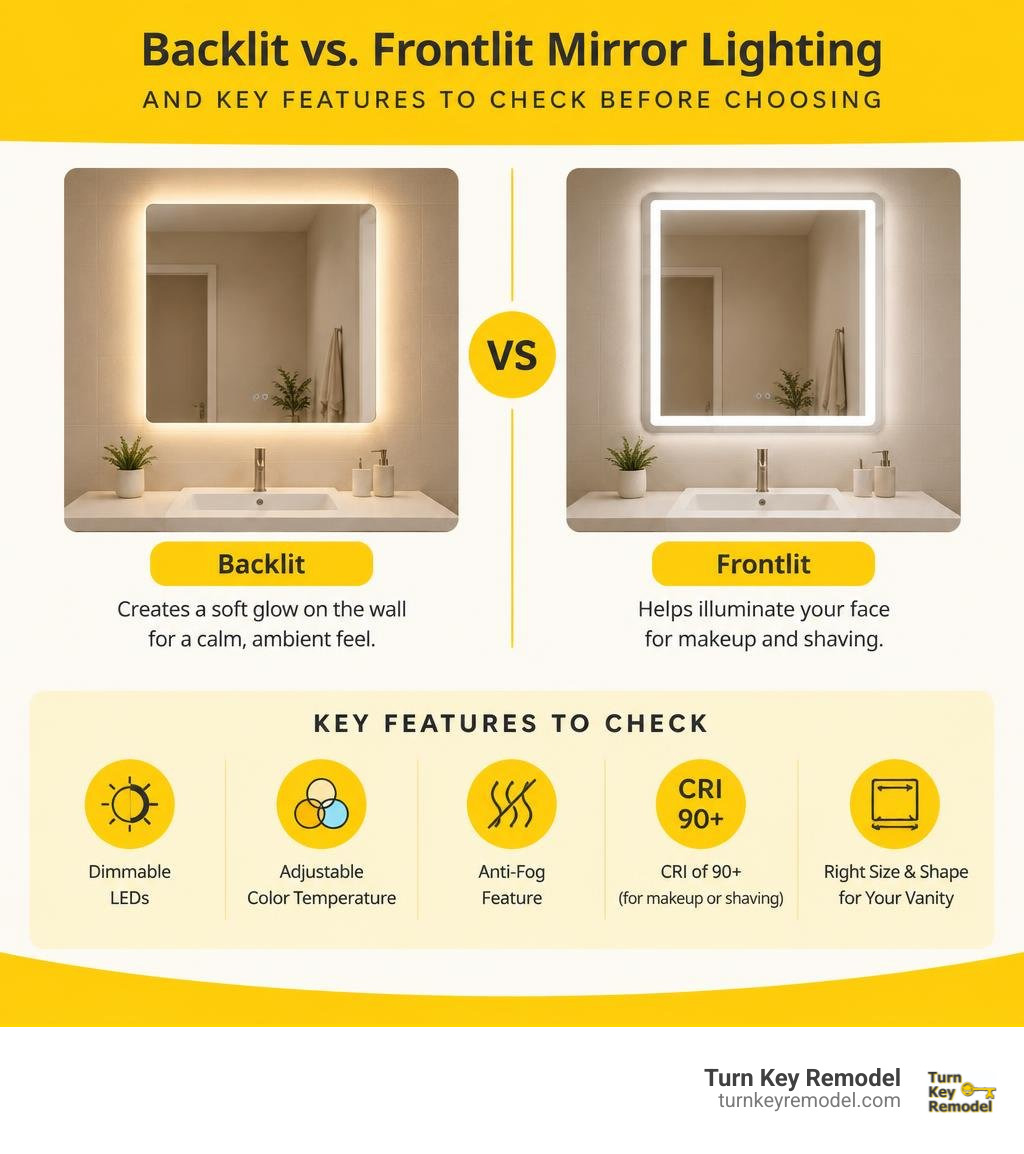
Bathroom backlit mirror basics:
What Is a Backlit Mirror and How Does It Work?
A backlit mirror is an illuminated mirror featuring an integrated LED strip mounted along the rear perimeter of the glass framework. Unlike conventional bathroom mirrors paired with traditional overhead light bars or wall sconces, a backlit unit directs light outward toward the surrounding wall surface. This design casts a radiant, indirect halo around the entire fixture, effectively separating the glass visually from the drywall and creating a weightless, floating aesthetic.
The mechanics behind this floating effect rely directly on wall reflectance and optical diffusion. The rear-mounted LED diodes emit light against your bathroom’s wall finish, which acts as a secondary reflector. Because the light source bounces off the wall before reaching your eyes, the illumination scatters evenly across the room without harsh glare, harsh shadows, or exposed hot spots. In contemporary home design throughout Yorba Linda and Anaheim Hills, this diffuse illumination brings both functional task visibility and soothing architectural ambiance to modern washrooms.
Modern LED mirrors represent a massive leap forward in energy efficiency compared to legacy incandescent fixtures. High-efficiency diodes use substantially less electricity while delivering between 1,300 lumens per meter to well over 6,000 total lumens depending on the overall fixture dimensions. With operating lifespans easily surpassing 30,000 to 50,000 continuous hours, a backlit unit eliminates the regular bulb replacements associated with old vanity bars while significantly decreasing your home’s daily electrical draw.
Backlit vs. Frontlit Mirrors: Understanding the Difference
When selecting illuminated mirrors, many homeowners wonder how backlit models compare against frontlit or dual-lit alternatives. While both integrate solid-state LED technology directly into the mirror assembly, they serve distinct lighting purposes in bathroom design.
A backlit mirror projects its light backward against the wall, creating a calming, ambient glow that provides secondary accent lighting and softens room contours. A frontlit mirror incorporates etched or frosted glass bands along the front perimeter, projecting light directly forward onto the viewer’s face. For spaces requiring maximum task precision alongside mood lighting, combination mirrors feature dual light paths that supply both perimeter backlighting and forward-facing task illumination.
| Feature / Attribute | Backlit Mirror | Frontlit Mirror | Dual-Lit (Front & Backlit) Mirror |
|---|---|---|---|
| Light Direction | Projects backward against wall | Projects forward through frosted border | Projects simultaneously front and back |
| Primary Lighting Role | Ambient, accent, soft perimeter | Direct task lighting (shaving, cosmetics) | Comprehensive task and ambient balance |
| Glare Level | Ultra-low (fully indirect diffusion) | Low to moderate (diffused through glass) | Balanced with independent dimming |
| Visual Depth | High; creates prominent floating effect | Moderate; clean flush profile | High; maximum depth and facial clarity |
| Typical Power Draw | 30W – 40W | 35W – 45W | 45W – 60W |
| Ideal Bathroom Placement | Powder rooms, spa master baths | High-traffic guest baths, vanity counters | Primary luxury master suites |
Key Features to Consider in a Bathroom Backlit Mirror
Evaluating illuminated fixtures requires understanding key performance specifications so your mirror performs reliably in daily use. From optical clarity to electrical moisture seals, paying attention to hardware specifications ensures lasting quality.
One vital feature to examine is the internal lighting structure. Modern luxury options like the Claris Organic mirror incorporate dotless LED technology that eliminates visible diode spotting and reflections on adjacent walls. Smooth, continuous light diffusion keeps perimeter halos uniform from corner to corner.
Adjustable color temperature allows you to tailor bathroom illumination to specific times of day or tasks. Quality units provide step-less or selectable color options ranging from warm 3000K (reminiscent of golden hour ambiance) to balanced 4500K neutral light, up to crisp 6000K or 6500K daylight. Switching between settings allows you to transition seamlessly from precise morning skincare routines to relaxing evening baths.
Moisture resistance is equally essential. Bathrooms present high-humidity environments, making ingress protection ratings crucial:
- IP44 Protection: Protects internal components against solid objects larger than 1 mm and water splashing from any angle. This rating is standard for general vanity installations outside immediate shower spray zones.
- IP65 Protection: Delivers complete dust-tight sealing alongside protection against direct low-pressure water jets, making it the preferred standard for compact, steam-heavy bathrooms and wet zones.
Color Rendering Index (CRI) and Light Quality
Color Rendering Index (CRI) measures a light source’s ability to reveal the true colors of objects, surfaces, and human skin compared to natural daylight on a scale from 0 to 100. For any mirror used for personal grooming, skin analysis, or makeup application, CRI is the single most critical optical specification.
Standard residential LED lighting often carries a modest CRI rating between 75 and 80. Under this level of illumination, skin tones can appear flat, washed out, or unnaturally sallow, leading to over-applied makeup or missed spots while shaving. For accurate, true-to-life reflections, you should look for fixtures built with a CRI of 90 or greater. Premium models, such as the Round Backlit Bathroom Mirror, boast a CRI rating of 95% or higher. High-CRI emitters render natural skin tones faithfully, eliminate muddy facial shadows, and guarantee that the colors you see in your bathroom reflect accurately outdoors.
Smart Controls and Anti-Fog Demister Pads
Modern backlit mirrors feature helpful electronic controls that simplify your morning routine:

Integrated demister pads use an ultra-thin, low-voltage heating element affixed behind the mirror glass. When activated, the pad gently warms the center glass surface just above room dew point, preventing steam from condensing during hot showers. Advanced models include safety auto-shutoff timers that turn the heating pad off after 30 to 60 minutes.
Touch sensors mounted directly onto the mirror face provide smooth, step-less dimming by holding your finger against the sensor until the desired brightness is reached. Memory modules store your exact brightness and color temperature preferences, restoring them the next time you tap the light on. For wet hands, touchless infrared sweep sensors allow you to control power with a wave of your hand; just be sure to allow at least 15 cm of clearance around the sensor edge to prevent accidental triggering from side walls or tall faucets.
How to Choose the Right Size, Shape, and Style
Selecting the right dimensions and silhouette balances your vanity visually and creates an inviting focal point. A mirror that is too large can overwhelm custom cabinetry, while a mirror that is too small leaves your wall feeling empty. Our team at Turn Key Remodel regularly guides clients through our custom bathroom design services to ensure every fixture aligns with surrounding vanities, tile, and plumbing.

Sizing Your Bathroom Backlit Mirror Above the Vanity
Finding the right mirror size involves a few standard design guidelines:
- Width Proportions: Your mirror should never extend past the outer edges of your countertop. The ideal width is generally two to four inches narrower than your vanity base on each side. For example, a standard 36-inch vanity pairs naturally with a 28-inch to 32-inch wide mirror.
- Vertical Placement: Position the center of the mirror at average eye level, typically 58 to 64 inches above finished floor height. Maintain approximately 4 to 8 inches of clearance between the top of your vanity countertop (or backsplash) and the bottom edge of the mirror glass.
- Dual Basin Layouts: For double-sink vanities in larger master suites in Tustin or Brea, you can either install one expansive panoramic mirror spanning both basins or hang two separate, identical mirrors centered over each individual sink. Centering individual mirrors over each sink helps define distinct grooming stations while maintaining clean symmetry across the room.
Popular Shapes and Frame Options
The shape of your mirror sets the visual tone for the entire room:
- Rectangular and Square: Timeless and clean-lined, rectangular shapes provide expansive reflective area. They can be mounted horizontally to accentuate room width or vertically to emphasize ceiling height.
- Arch and Semi-Circular: Arched designs, like the Ark 50 cm mirror, blend classic architectural curves with modern backlighting to soften straight tile lines.
- Pill and Capsule Ovals: The elongated curves of pill-shaped mirrors, such as the Pill oval LED mirror, add vertical flow to compact powder rooms.
- Frameless vs. Framed: Frameless mirrors featuring polished, diamond-cut edges offer a clean, minimalist look. Alternatively, choosing metal frames in matte black, brushed gold, or brushed nickel lets you coordinate directly with your plumbing hardware. You can browse our bathroom remodel gallery to see how various frame finishes complement custom tile and vanity designs.
Installation, Electrical Setup, and Maintenance Guide
Installing an illuminated LED mirror requires proper mechanical wall anchoring and code-compliant electrical planning.
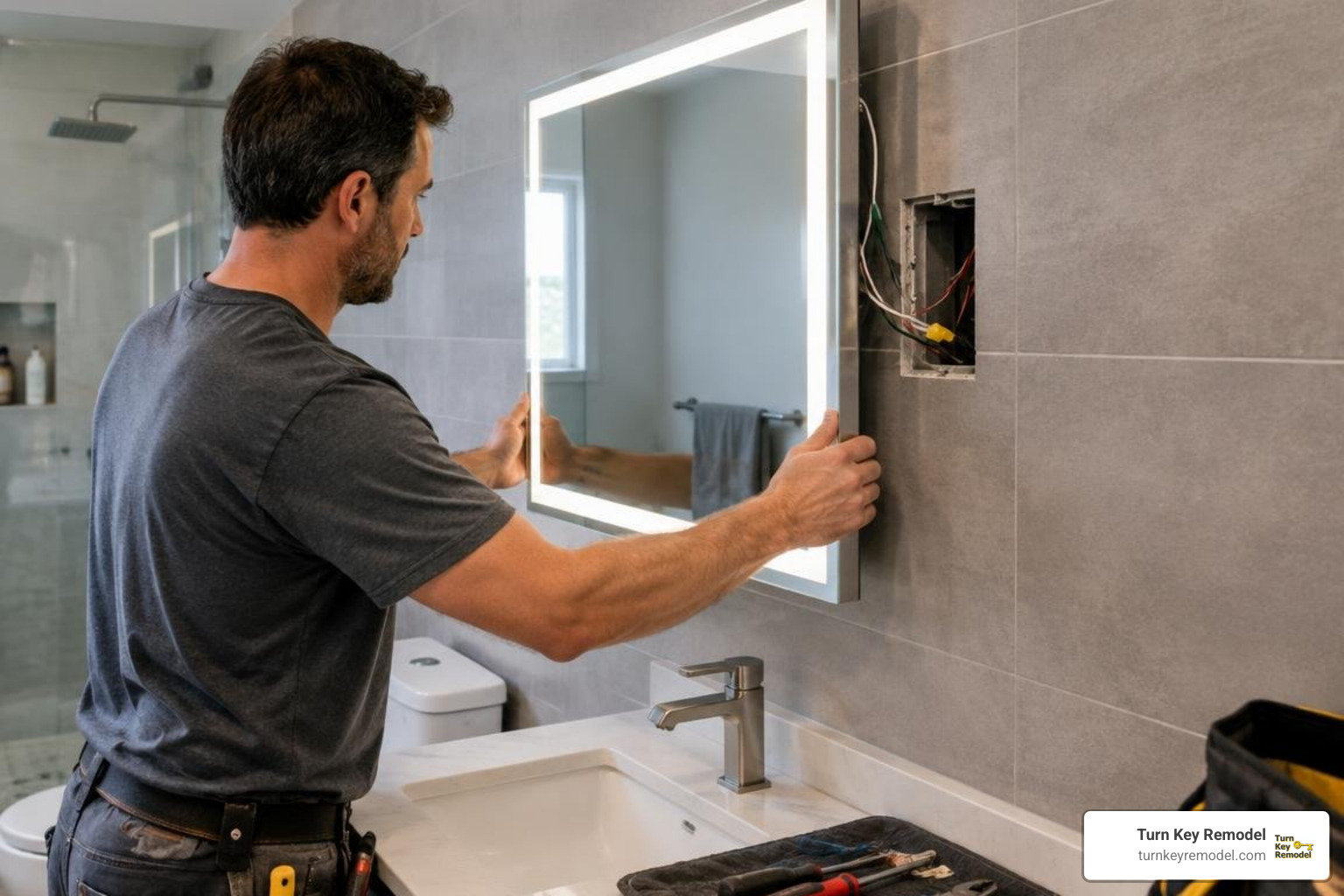
You can power your mirror using one of two primary methods:
- Plug-In Installation: Some mirrors come equipped with a standard three-prong electrical cord. If your bathroom layout includes an adjacent electrical outlet, you can hang the mirror and plug it directly in. However, visible cords can disrupt a clean aesthetic.
- Direct Hardwire Installation: Hardwiring connects the mirror’s internal LED driver directly to a dedicated recessed junction box hidden behind the glass. This approach conceals all wiring and allows you to control the mirror via a standard wall switch.
Because electrical connections in moisture-heavy environments require strict adherence to safety standards, installations should comply with safety codes and local building requirements. When remodeling in Orange County, review local codes like the Orange County Residential Bathroom Remodel Requirements to ensure full GFCI branch circuit compliance.
Maintaining your LED mirror is straightforward:
- Always apply glass cleaner or diluted vinegar to a microfiber cloth first rather than spraying the mirror directly, preventing liquids from seeping behind the edge seal.
- Avoid ammonia-based or abrasive cleaners that can damage silvering along the glass edges over time.
- Gently wipe down touch-sensor buttons and outer frame surfaces using a dry or slightly damp lint-free cloth.
Is a Bathroom Backlit Mirror Good for Makeup and Daily Grooming?
Backlit mirrors excel at establishing a clean, spa-like ambiance, but their effectiveness for close-up makeup application depends on their configuration. Because a pure backlit mirror directs light backward against the wall, it functions primarily as an ambient glow rather than a direct task light.
For detailed grooming, shaving, and makeup routines, choose a hybrid dual-lit mirror that features both perimeter backlighting and forward-facing front light. Alternatively, pair a pure backlit mirror with complementary architectural lighting, such as a pair of wall sconces mounted at eye level on either side of the glass, or dedicated recessed ceiling downlights focused directly over the sink basin. This balanced approach provides comfortable ambient light alongside clear, shadow-free illumination for your morning routine.
Frequently Asked Questions About Backlit Bathroom Mirrors
Do I need a licensed electrician to install a backlit mirror?
If you are using a pre-installed cord with a standard wall outlet, you can mount the mirror yourself using the provided bracket system and wall anchors. However, for a direct hardwire setup where high-voltage lines connect behind the mirror, we strongly recommend hiring a licensed electrician. Professional electrical work ensures the hidden junction box is properly grounded, tied into a GFCI-protected circuit, and installed in compliance with regional building codes.
How much energy does an LED backlit mirror consume?
LED backlit mirrors are exceptionally energy-efficient. Most standard residential units draw between 30 watts and 45 watts when active, even with anti-fog heating pads running. Assuming an average electricity rate and two hours of daily use, operating an LED mirror typically adds just pennies per month to your utility bill. Furthermore, high-grade LED diodes are engineered to last up to 50,000 operational hours—equivalent to over 20 years of typical daily use.
What warranty and support coverage should I expect?
Reputable mirror manufacturers typically provide a dual-tiered warranty structure. Glass panels and structural mounting frames often include coverage ranging from 3 to 5 years, while sensitive electronic modules—such as LED drivers, touch sensors, and defogger pads—are usually covered by a 2-year limited warranty. Premium manufacturers also provide extended technical support to assist with troubleshooting, sensor recalibration, or replacement components over the life of the product.
Conclusion
Upgrading to a backlit mirror transforms an ordinary vanity into a modern focal point. By pairing soft, floating perimeter light with convenient features like anti-fog heating and high-CRI color rendering, you can enjoy a bright, comfortable space for both morning prep and evening relaxation.
At Turn Key Remodel, we bring more than two decades of dedicated design-build experience to residential renovations throughout Orange County, Yorba Linda, Placentia, Anaheim Hills, Tustin, and Brea. Whether you are planning a simple vanity refresh or a complete master bath overhaul, our team provides end-to-end project management, in-house interior design, and 24/7 client communication. Explore our comprehensive custom bathroom remodeling services to start designing your dream space today.